Not long ago, companies competed on who could collect the most data.
Today, they compete on who can analyze it fastest.
Tomorrow?
They'll compete on who can think with it.
That may sound like a bold prediction, but it's already beginning. As AI becomes part of everyday business, organizations are discovering something surprising: having more data isn't the advantage they thought it was. The real advantage is whether AI can understand what that data actually means.
That's why we believe the next major enterprise technology isn't another chatbot or another foundation model.
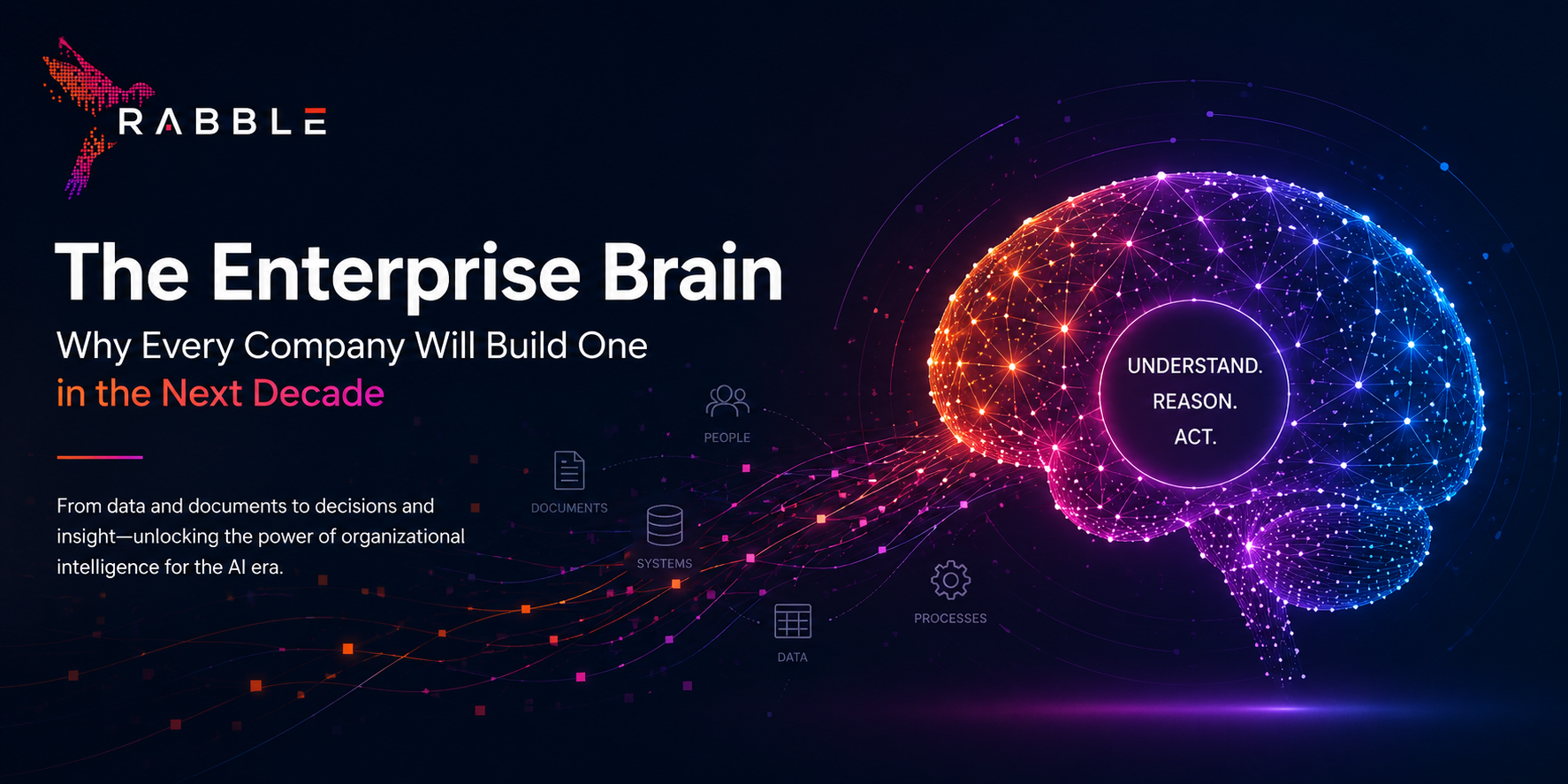
It's the Enterprise Brain.
What is an Enterprise Brain?
Think of it as your organization's collective knowledge, connected and accessible in a way that AI can reason with.
It isn't another database.
It isn't another document repository.
And it certainly isn't just another AI assistant.
An Enterprise Brain connects the relationships, business rules, historical decisions, terminology, and institutional knowledge that live across your organization. Instead of simply storing information, it provides the context needed for AI to make better decisions.
In other words, it helps AI think more like your business thinks.
Every Technology Era Solved a Different Problem
Over the past few decades, enterprise software has evolved in predictable steps.
- ERPs helped companies digitize transactions.
- Data warehouses helped companies analyze information.
- SaaS platforms digitized workflows.
- AI is now forcing companies to digitize something they've never had to formalize before: organizational intelligence.
For years, humans filled in the gaps. We knew why a field existed, why a customer was handled differently, or why a process changed after an acquisition.
AI doesn't know any of that unless you teach it.
The Biggest Risk Isn't Bad Data
Most conversations about AI readiness focus on data quality.
Clean the data.
Label the data.
Govern the data.
Those things matter.
But they aren't the biggest challenge.
The real problem is missing context.
Imagine asking AI:
"Why do customers in this region follow a different approval process?"
The answer probably isn't sitting in a table. It's scattered across meeting notes, documentation, emails, spreadsheets, and, most importantly, inside the heads of people who have worked there for years.
Without that context, AI can produce answers.
It just can't produce your answers.
Your Greatest Competitive Advantage May Be Walking Out the Door
Every time an experienced employee retires, changes roles, or leaves the company, they take years of unwritten knowledge with them.
Not because anyone failed to document it.
Because much of it was never considered documentation.
It's the exceptions.
The shortcuts.
The reasons behind decisions.
The relationships between systems.
The unwritten "this is how we've always handled it."
Historically, businesses accepted this as a normal cost of turnover.
In an AI-driven world, it becomes a strategic risk.
The Future Belongs to Companies That Preserve Context
The organizations that get the most value from AI won't necessarily have the biggest models or the largest budgets.
They'll have something much harder to replicate.
They'll have context.
Their AI will understand how the business operates, how teams make decisions, and how information connects across systems.
That understanding becomes a competitive advantage that grows over time.
While competitors are rebuilding knowledge every time people leave, these organizations continue expanding what their AI knows.
Building an Enterprise Brain Starts Earlier Than You Think
Many organizations assume they'll build this capability after they've rolled out AI.
In reality, the opposite is true.
The companies making the fastest progress are building the foundation first. They're capturing business meaning, connecting disconnected information, and creating the context AI needs before expecting autonomous agents to deliver meaningful results.
The result isn't just better AI.
It's a smarter organization.
The Next Decade Will Belong to Context
AI models will continue to improve.
Computing power will become cheaper.
Capabilities that seem revolutionary today will eventually become expected.
What won't become a commodity is your organization's unique knowledge.
Every company has data.
Every company has documents.
Very few have a way to turn decades of business knowledge into something AI can truly understand.
That's the difference between using AI and building an organization that can grow with it.
The companies that lead the next decade won't simply have more artificial intelligence.
They'll have an Enterprise Brain.
And that may become their most valuable asset of all.
Need help with your context layer?
.png?width=2026&height=1768&name=RABBLE%20305-PNG%20NO%20BACKGROUND-WHITE%20FONT%20(2).png)